


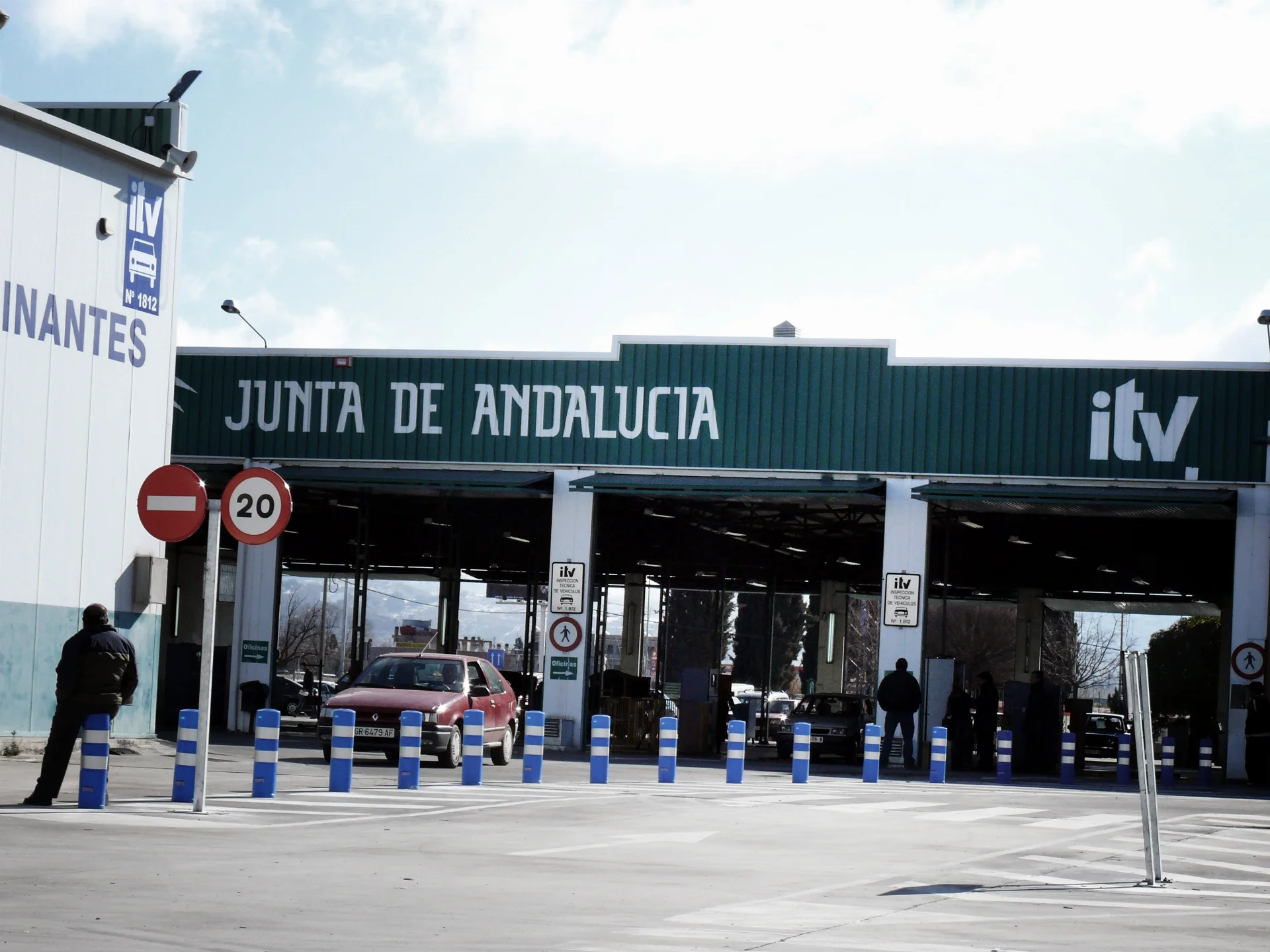
The ITV test in Spain is something you get to know, and dread, once you make the move and get your own car. If you buy new, it's smooth sailing for the first four years. After that it's every two years, and every year once the car turns ten. I've been through a few myself, in several cars, and I've sat through my grandpa's in his Mini and in his Porsche Macan. I've booked it for a dozen clients. So I can tell you how to make it easy, that it isn't so bad, and how to avoid waiting for no reason at all.
What the ITV test in Spain is
ITV stands for Inspección Técnica de Vehículos, the roadworthiness test. It's the MOT, the besiktning, the TÜV. In Andalucía every station belongs to Veiasa, a company owned by the Junta de Andalucía, so there are no private stations to shop between and the price is the same from Algeciras to Almería. A technician checks that the car is safe and clean enough for the road, and the result goes straight to the DGT, the traffic authority. The law behind it is Real Decreto 920/2017, which I've read so you don't have to.
How often your car needs it
| Vehicle | First ITV | Then |
|---|---|---|
| Car | 4 years after first registration | Every 2 years until it's 10, then every year |
| Motorbike | 4 years | Every 2 years |
| Moped | 3 years | Every 2 years |
| Van or pickup under 3,500 kg | 2 years | Every 2 years until 6, every year until 10, then every 6 months |
| Caravan over 750 kg | 6 years | Every 2 years |
| Trailer over 750 kg | Every year from the start | Every 6 months from 10 years |
The clock starts at the first registration, not the day you bought the car. A three year old car bought second hand has its first ITV a year after you get it. The date is on the sticker and on the tarjeta ITV, the card that lives in the glovebox.
You can go up to 30 days before the date without losing anything. The new expiry counts from the old date, not from the day you went. So book for the first days of that window and nobody is in a rush, least of all you.
How you find out it's due
The sticker on the windscreen shows the month and the year. Veiasa texts you as well. Mine arrived on 15 July for an ITV due on 14 August, from a sender called ITV-VEIASA, with a link to book. The old letter in the post is gone. You register the plate once on Veiasa's notification service and from then on it's an email or an SMS. The miDGT app shows the date too, next to your licence, and warns you when it's close. If you already use the app for your licence, you have this.
The confirmation comes by SMS, with the station, an odd minute like 12:14, and a locator code. Keep it. The day before, another SMS arrives with a link, and that link matters, as you'll see further down.
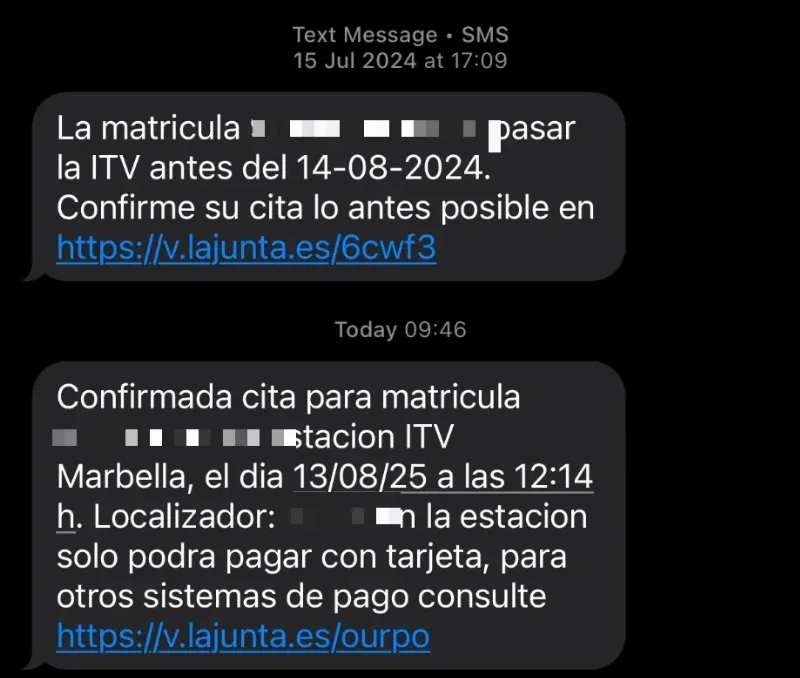 The reminder and the confirmation, as they arrive. Plates and the locator blurred.
If the car is leased or on a subscription
The car isn't yours, but the ITV is still your appointment. The leasing company owns the car, so the reminder reaches them, and they tell you. With ALD, my lease sent me a voucher, a vale de autorización, to hand in at the counter. The station bills the leasing company and you pay nothing.
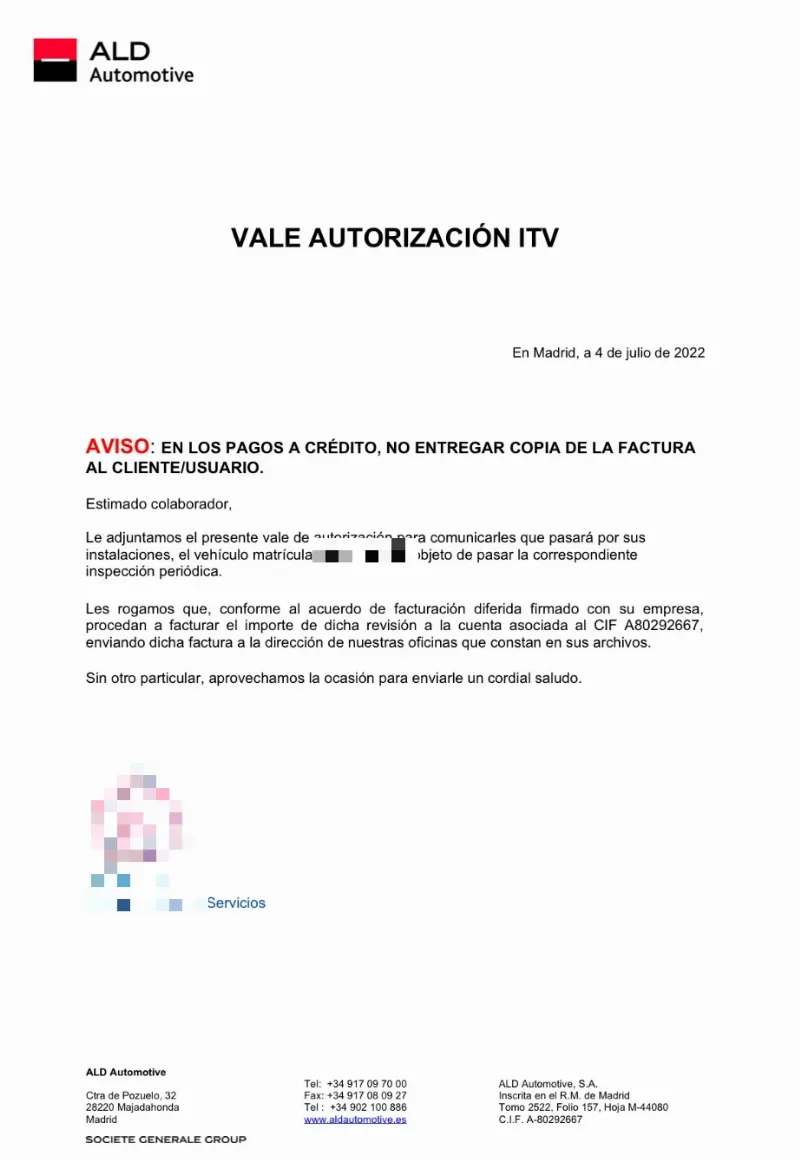 The voucher from ALD. Hand it in at the counter and the station bills them, not you.
With Bipi, the subscription people, they booked it for me and then emailed afterwards, with some urgency, asking me to confirm that the car had passed. A rental car is the one case where none of this is your problem.
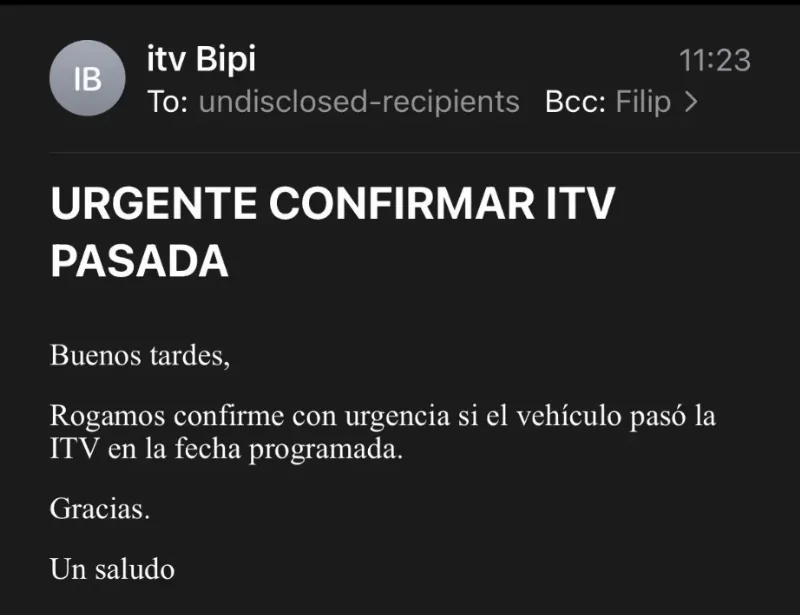 Bipi, the morning after the appointment.
How to book
Book on itvcita.com, Veiasa's only booking site, or call 959 999 999. The site is in Spanish and, for some reason, Dutch. No English. You need the plate and either the first registration date or the last six digits of the chassis number, both on the permiso de circulación. Online booking only works for cars registered in Andalucía. A car with Madrid or Barcelona plates books by phone. Walking in without an appointment gets you nowhere. Veiasa's own words are that only customers with an appointment are seen.
Pick a morning. The waiting bays at San Pedro, and at most stations, sit in full sun. An afternoon slot in August means sitting in your car with the air conditioning running, assuming it works, as it should. Stations open at 6:45 on weekdays. Saturdays open only on the dates Veiasa publishes, and in July and August there are none.
You can pay online when you book, or at the station. If you booked without paying, the confirmation SMS reminds you of the rule: at the station it's card only. No cash. There is officially a way to pay cash, with a payment letter at a Unicaja branch three days before, and I have never seen anyone do it.
What to bring and what it costs in 2026
Two papers: the permiso de circulación and the tarjeta ITV, the original, because it gets stamped. Insurance isn't asked for when it's on the DGT's register, which it is for any Spanish policy. Bring your licence and an ID anyway; the counter sometimes asks. If it's a retest after a fail, bring the name or CIF of the garage that did the repair.
Veiasa's prices are the same at every station in Andalucía. These include VAT and the €4.18 DGT fee:
| Vehicle | Price |
|---|---|
| Petrol car under 1,600 cc | €33.28 |
| Petrol car of 1,600 cc or more | €43.52 |
| Diesel car under 1,600 cc | €38.39 |
| Diesel car of 1,600 cc or more | €48.62 |
| Electric or hybrid car | €29.11 |
| Motorbike over 125 cc | €25.79 |
| Retest within 2 months of a fail | Free |
Pass it before the date and Veiasa takes 10% off the base fee. Turn up more than a month late and it adds 12%. These are the prices on Veiasa's page in October 2026. The base tariff dates from 2016 and only the DGT fee has moved since.
Where to go on the Costa del Sol
Every station is Veiasa's, so pick the nearest. I always go to San Pedro, because it's the closest to Cancelada and it's simple. I've done Estepona too: same bays, same procedure, same sun. The one people call ITV Marbella is in San Pedro de Alcántara, in the polígono behind the town. There is no station in Fuengirola, Benalmádena or Torremolinos. The coast between Marbella and Málaga goes to Mijas, in Las Lagunas.
| Station | Adresse | Téléphone |
|---|---|---|
| Algeciras, the nearest for Sotogrande | Polígono Cortijo Real, Calle Deseos 2 | 856 108 034 |
| Estepona | Polígono Industrial, Calle Graham Bell 15 | 951 506 164 |
| San Pedro de Alcántara, the Marbella station | Polígono Industrial San Pedro, parcela 25 | 951 216 991 |
| Mijas | Calle Macharaviaya 1, Las Lagunas | 951 917 065 |
| Málaga, Guadalhorce | Polígono Guadalhorce, Calle Diderot 1 | 951 772 136 |
| Málaga, El Viso | Polígono El Viso, Calle Brasilia 22 | 951 917 072 |
| Málaga, El Palo | Calle Escritor Fuentes y Cerdá 2 | 951 770 097 |
| Algarrobo, for Vélez, Torrox and Nerja | MA-103, km 1.9 | 951 707 108 |
The quickest way to find yours is to type ITV into Google Maps; the nearest station comes up with its hours and its queue of reviews. All of them open Monday to Friday from 6:45 to 20:45, and from 7:45 to 12:45 on the Saturdays in Veiasa's calendar. The Friday before an open Saturday closes at 19:45. They close on the public holidays, Andalucía's included.
The day itself, from the driver's seat
You arrive to a car park and three to five numbered bays, with a big LED screen showing number plates and the bay each one goes to. Here is the first mistake everyone makes: being on time and assuming your plate will come up. It won't, until the station knows you're there. Get out of the car and walk into the office. Say you have an appointment, show the papers, pay if you haven't, and from that moment you exist. Find the most charming person at the counter and ask it straight: I'm here, I have an appointment, how do I make sure I get called. That is the number one thing to do.
There are machines in the office too, the aquí estoy terminals, where you type the plate and pay by card. And Veiasa has a newer trick called Directo a Línea: the SMS you get the day before carries a link, you press it once when you've parked, and you never go near the office. In my experience the machines rarely work, so I walk up to the counter with my charmiest and hurried "buenos días, señorita" and I'm done in a minute. When the link works, use it.
Then back to the car, and you sit until your plate shows with a bay number. You drive in and meet your technician, who stays with you for the whole lane, fifty metres or so of it.
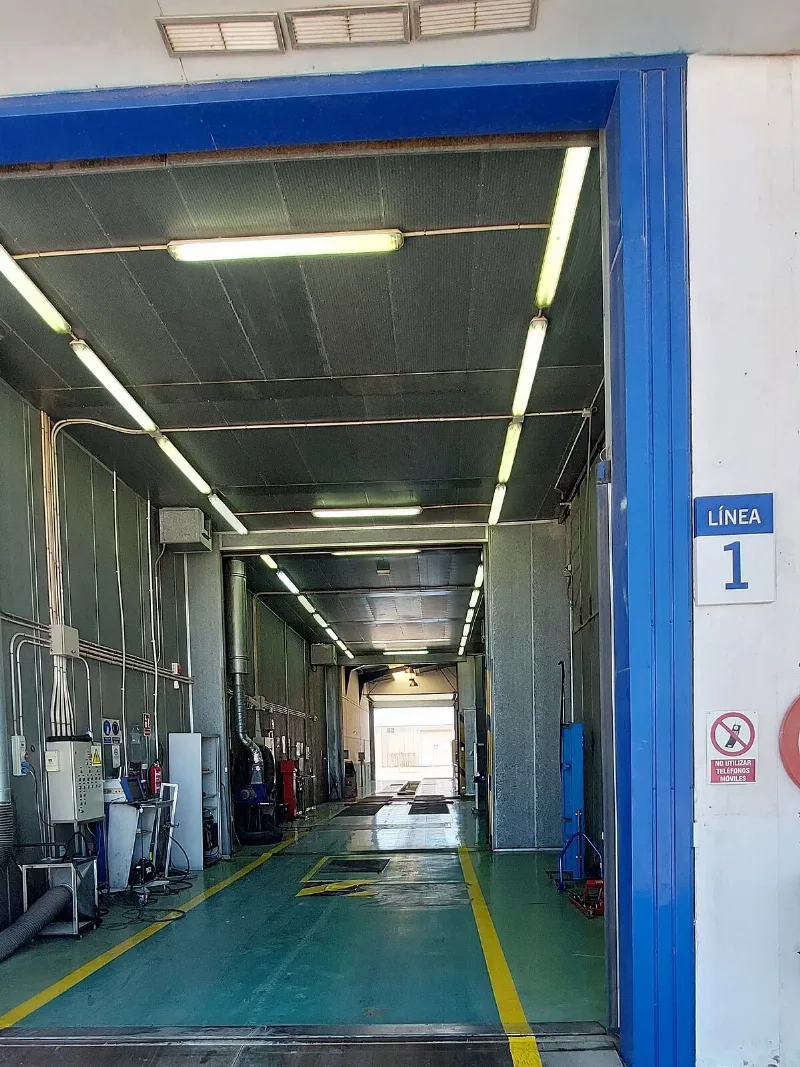 A bay at Veiasa's station in Albox. Photo: Carlosjvives, CC BY-SA 4.0, cropped.
It starts with the simple things. He stands in front, then behind, and calls them out: left indicator, right indicator, brake, dipped lights, full beam, fog lights, horn, wipers, reverse. You sit in the driver's seat with the engine running and do as you're told. (This is also usually where you completely freak out and forget how to use the car's instruments, as if you've never driven in your life.) He reads the mileage and looks the car over: tyres, windscreen, plates, belts, the chassis number against the papers. Then the exhaust. A probe goes in the tailpipe and you rev when asked, and a diesel gets asked to rev hard.
You roll forward five metres to the next station, and then up onto the rollers, which can be a bit awkward if you didn't give it enough gas, or overshoot. This is the part that feels strange the first time. The wheels spin on the rollers while the car stays put, and he tells you to accelerate and keep accelerating, then brake, then harder, then the handbrake, while an arrow on a screen shows the force. Your job is to keep the arrow where he says.
The last station is the pit. He goes under the car with a lamp, and from down there he calls out (in some stations he'll leave a walkie-talkie with you so you can hear him better): turn the wheel left, turn it right, brake, and the plates under the wheels shake the suspension about. It's awkward if you haven't done it before, and you're a little nervous anyway. It's fine. You're doing nothing a driving instructor hasn't made you do.
And then nothing happens, which is the good news. If he says nothing, you've passed. Feel free to ask, though. You get the stamped tarjeta and a sticker, and you stick it yourself on the inside of the windscreen, top right corner. That's that.
Officially you go through alone. Veiasa's rule allows children and people who depend on you as passengers, nobody else. I went through with my grandpa as his translator, in the Mini and in the Macan, and nobody said a word. I also wasn't needed, which brings me to the language.
The Spanish you'll hear
The test is in Spanish, but there isn't much dialogue once you're in the lane, and a good technician switches to hand signals or English when he sees the face. It depends who you get. These cover it:
Intermitente izquierdo, intermitente derecho: left indicator, right indicator
Freno: the brake. Frene: brake now. Freno de mano: handbrake
Luces de cruce: dipped headlights. Largas: full beam. Antiniebla: fog lights
Claxon: horn. Limpiaparabrisas: wipers. Marcha atrás: reverse
Acelere: accelerate. Suelte: release. Más: more. Ya: that's enough
Gire el volante a la izquierda, a la derecha: turn the wheel left, right
Apague el motor: switch off the engine. Arranque: start it
Avance: move forward. Pase a la siguiente: go on to the next station
It's really just sign and drive and brake and left blinker and right blinker. It isn't difficult, it might be frustrating, and with no Spanish at all you'll get by.
If something is wrong
There are three outcomes. Favorable means you passed, even with a minor defect noted. My stepdad's rear light had a crack; the technician passed him and told him to fix it. He didn't fail, he had homework. Desfavorable means a serious defect. You may drive the car to a garage and back to a station, nothing else, and you have two months from the first inspection to come back. The retest is free at any Veiasa station within those two months, and a third try costs about €11. Negativo means the car leaves on a truck. Miss the two months and you start again with a full inspection at full price.
What the technician says is simpler than the law. Fix this and get another appointment. He writes it on the sheet, so the garage knows exactly what to touch.
The pre-check question
Don't fall for the idea that you must pre-check the car at a garage before the ITV. Any garage will tell you that you should, and then quote you for it. If the car makes strange noises, the check engine light is on, both indicators are dead and the horn is silent, that isn't a pre-check, that's a service. You'd fail anyway and do the whole thing twice. Get it serviced first. A modern car that drives fine needs no paid rehearsal.
Walk around it the night before instead. Lights, including the plate lights and the brake lights with someone standing behind. Tyres. Wipers and washer fluid. No warning lights on the dash. No crack in the windscreen in front of the driver. That is the free pre-check, and it is the one that matters. Nobody I know has failed, though to be fair most of my clients drive rental cars, and the ones who buy, buy new.
Fines, and whether anyone looks at your sticker
Driving with the ITV expired is a serious offence: €200, no points. With a negative result it's €500, and the police can immobilise the car on the spot. Which police, and what happens when a car is towed, is in the emergency numbers guide. There is no grace period. The day after the date you're driving without it, appointment or not, which is why the 30 day window exists.
Nobody looks at your sticker. The police don't walk around car parks reading windscreens. But if there's an ITV campaign, and the DGT runs them, or if you get stopped for anything else and they run your plates, the expired ITV comes up on their screen at once. It isn't a red light on your car. It's a line in a database, and the database always wins.
Foreign plates and imported cars
The reality first. You will see a lot of foreign plates on this coast. A lot. In Marbella it sometimes feels like more than Spanish ones, and in Puerto Banús the German plates are everywhere, not because the drivers are German but because the car was cheaper to buy there, and most of those are rentals anyway. I know people who have driven here on their home plates for years. So let's deal with the question everyone has: what if you use the car in Sweden, or Germany, and in Spain? Of course you're not changing plates for a summer.
Now the law. The obligation follows you, not the car. An EU citizen passing through needs no paperwork at all. The day you become a resident here, you have one month to put Spanish plates on it, 60 days if you moved your residence with the car, and if the paperwork drags, the DGT gives you temporary green plates for two months, extendable. Once that time is up, the car can't be on the road until it's registered.
How it plays out on the road is different. Nobody knows your day one until you're stopped. Get stopped and they ask, and from then on your clock is known. Get stopped again on the same plates and the fine follows. It isn't heavily enforced, and you can usually promise you'll sort it out. That's my experience. The paragraph above is the law, and when the fine comes, the law is what counts.
Getting Spanish plates means a first ITV of a different kind, the inspection for registration, where the station draws up the Spanish technical card from the European certificate of conformity, the CoC, or from a ficha reducida written by an engineer. It costs about €120 to €129 at Veiasa. A car from outside the EU needs the H1 import certificate as well and has to meet European homologation. The DGT explains the papers for a car from the EU and for one from outside it.
A few of my clients have brought cars over, well kept ones, and none failed. Once the car is Spanish it's on the normal calendar from its original registration date. A six year old import does its first Spanish ITV straight away and comes back every two years.
The short version: how to pass the ITV
The ITV is not the dragon people make of it. Book a morning slot inside the 30 day window, tell the counter you're there, do what the man says, and put the sticker on yourself. Then forget about it for two years. If something about your own car doesn't fit the above, ask in the Estepona or Marbella room and I'll answer. And if the car is the next thing on your list after the house, the real costs of owning here and the taxes guide are where residency starts to matter.








Commentaires (0)
Aucun commentaire pour l'instant. Soyez le premier à en poster un.