



Most agents focus on the good. The sunshine, beaches, and Mediterranean lifestyle.
Few will tell you the full truth. Owning a home here comes with risks, and understanding those risks is key to protecting your investment. So let’s talk squatters, burglaries, and how to keep your home safe. No fluff.
Who Are Squatters Really
They are not who you think. You will not always spot them a mile away. In Spain, squatters exploit a law known as Ley de la Morada, which protects the sanctity of a home.
Squatters can be Spanish families who simply cannot compete with rental prices. Average monthly salaries range between €1600 and €2200, while weekly rents can easily exceed those amounts.
Spain does not have enough affordable housing accessible to the local population, while parts of the market are snapped up by investors renting short term to tourists.
If a squatter can prove they have been in a home longer than 48 hours, they can claim it as their residence.
From there, eviction becomes slow, expensive, and frustrating. Make no mistake, squatting is illegal. But the system is burdened and slow. Eviction is certain, but it can take months or even years.
And you will still be paying utilities. Water, electricity, community fees. Why. Because cutting them off is considered inhumane under Spanish law.
This is not just a legal issue. It is about time, cost, and potential damage.
Understanding the Risk of Burglaries
Burglaries are more direct. Someone breaks in and takes your things. But it is rarely random.
Homes without alarms or visible signs of occupancy are easy targets. Rental homes are especially vulnerable. Burglars know guests are arriving with cash, watches, and jewelry, often packed neatly in bags, ready to steal. The timing is often just after check in or when the property appears momentarily vacant. Make sure you thoroughly review your community rules to make sure your home meets all safety standards.
Even trusted workers or neighbors might unknowingly share information. A gardener on minimum wage might casually mention what they have seen to someone offering a few hundred euros in return.
Alarm Systems Are Non Negotiable
This is your best line of defense, and it is why I make sure every client installs one. The few that did not see the need. I paid the first few months myself to save them from future issues.
If an alarm goes off during a break in, it is treated as an active burglary. Centralized alarm systems are linked directly to the police, who are dispatched immediately to remove or catch the individual.
They are loud, they are visible, and they work. Squatters and burglars often target the house without an alarm instead.
And here is a legal tip. If a tenant overstays their lease or breaches the contract, activating the alarm can reclassify them as trespassers, which speeds up their removal process.
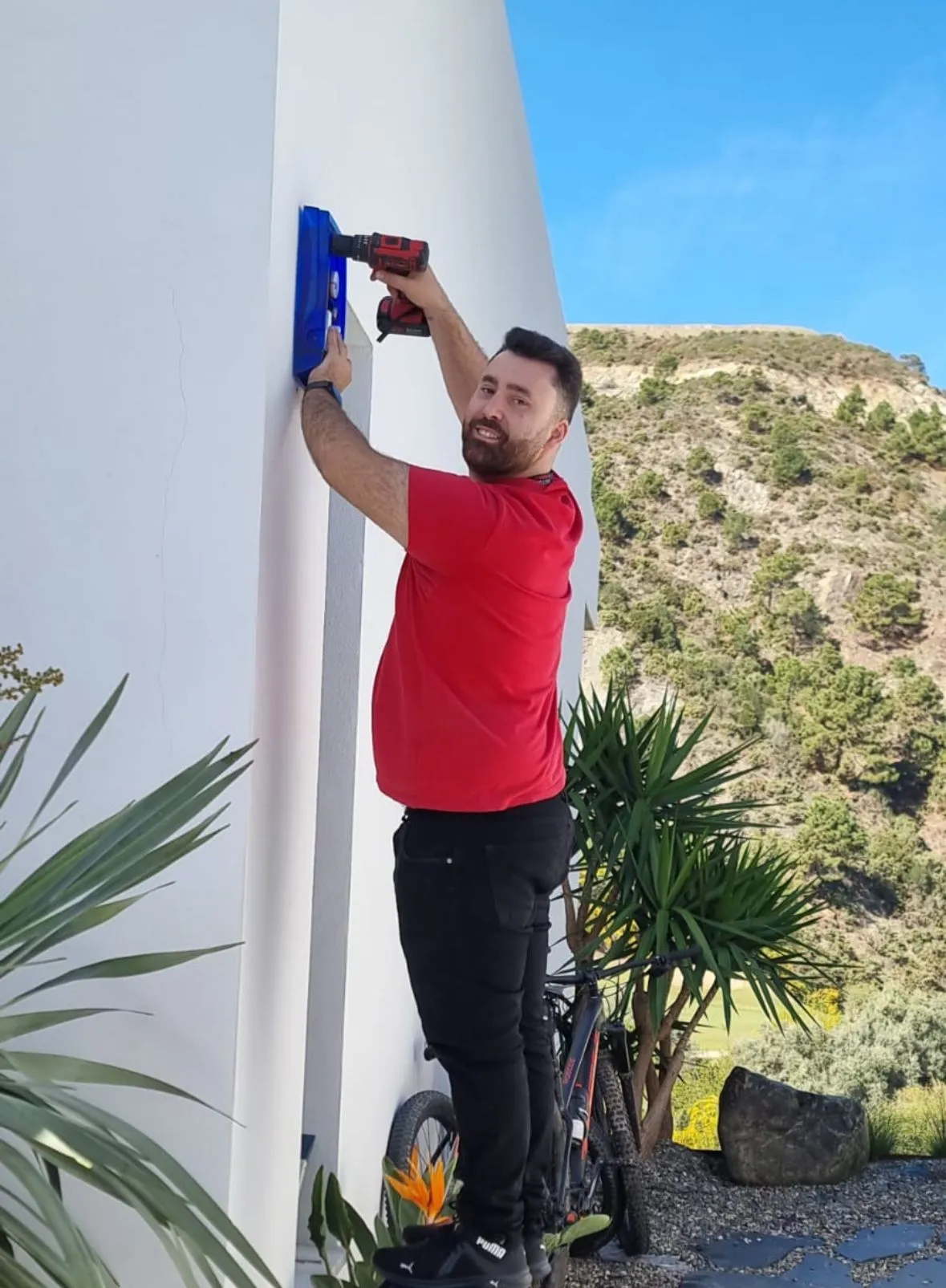 Marco from Sector Alarm
Consider Gated Communities
Many urbanizations in Costa del Sol are gated by design, not just luxury developments. These gated communities often time have Community rules for property owners make sure you are up to date on the rules for your community.
Controlled access means fewer unknown visitors, there is usually CCTV or n eighbor surveillance, and some even have 24.7 patrols. While not a guarantee, it is an added layer of protection that should not be overlooked.
Video Cameras and Privacy Laws
Cameras help, especially the kind you can check from your phone. But do not rely on them alone.
Spanish privacy laws state you can only record your private property. Cameras cannot be aimed at communal spaces or sidewalks. Of course, some accidentally tilt upwards after installation toward those areas.
If you are renting out, keep in mind Airbnb guests can report visible cameras in residences, even if they are photo only. For rentals, I recommend motion detectors instead. They are discreet, legal, and do the job.
Anti Squatter Companies. Last Resort
These companies operate in legal grey zones. They charge thousands and sometimes offer squatters cash to leave. Some claim to relocate them to other homes. Others attempt stakeouts and enter the property when the squatters leave, changing the locks.
Sometimes, these companies and squatters even work together behind the scenes. It is not the route you want to go unless all else fails. And it can usually be avoided with a €40 a month alarm system.
Insurance and What It Covers
Good home insurance should always be in place. It covers damages, theft, vandalism, and losses caused by squatters. It will not prevent problems, but it will reduce the financial impact if something happens.
Be Discreet With Your Property
Do not leave designer handbags or gadgets in clear view. Be mindful when moving in or showing the property to strangers. Even the most honest worker might talk if the right cash offer comes along.
Final Thoughts
This is not about paranoia. It is about prevention. Owning property here is a privilege, but it requires awareness and action.
If you take one thing from this guide, let it be this. Install an alarm system and do not assume it will not happen to you.
Every one of my clients has one, and for good reason.
Watch my video on squatters and burglaries in Costa del Sol for more.
https://youtu.be/jSDGmaswDH0?si=fozZd3mSNFZET9pF
If you ever want help understanding how to keep a specific type of home safe on this coast, I am always here to share what works in the real world.
And if you are considering installing an alarm system, speak directly with Marco Torrent from Sector Alarm. He is reliable, fast, and knows what works here better than most.
Tel +34 605 16 00 60
Email marco.torrent@sectoralarm.es










Comments (0)
No comments yet. Yours can be the first.